When the 15-day ceasefire was announced, it wasn’t just a pause, it was an opportunity. All three sides (the US, Israel, and Iran) could use this window to refine and strengthen their defensive capabilities. Iran, in particular, not only absorbed the damage from the past 40 days of American and Israeli strikes, but also collected valuable intelligence on the systems used against it. That data was then compiled and used to introduce small but significant changes to its own defense architecture.
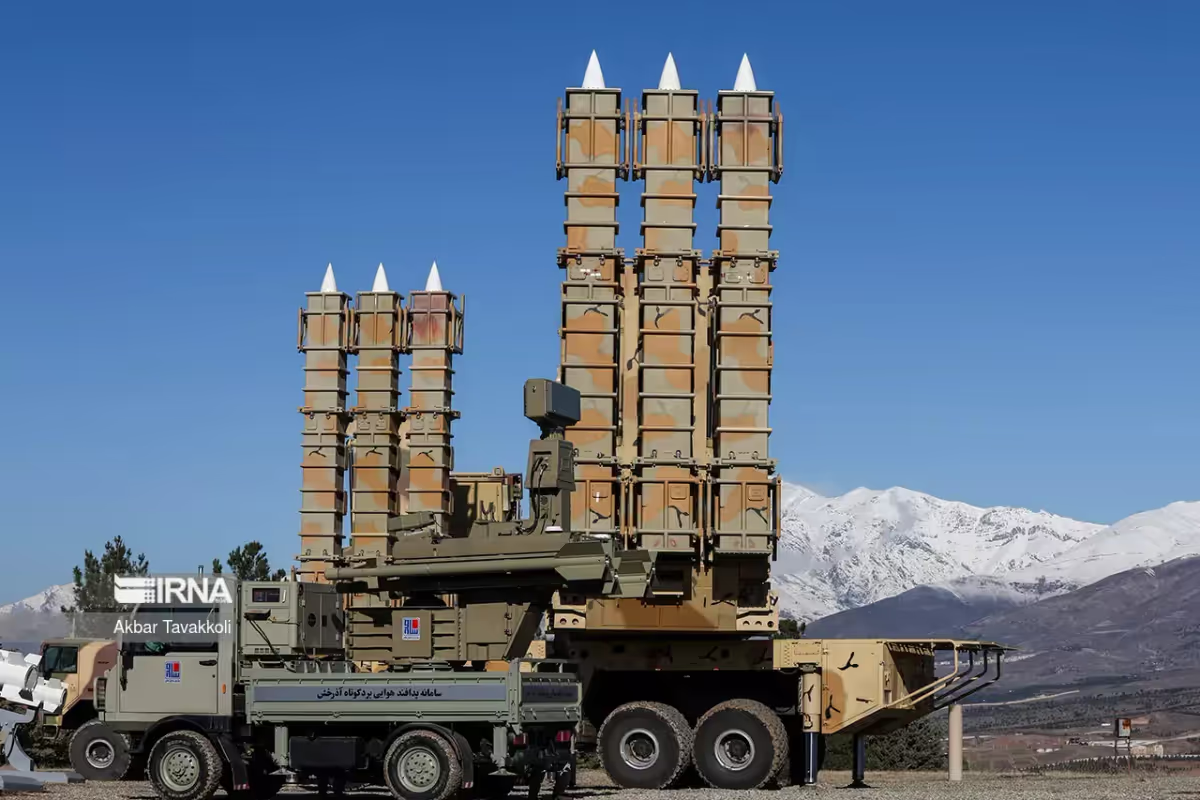
Among these changes is Iran’s SHORAD (Short-Range Air Defense) network, with the Qaem-118 being a key component that has proven quite effective against drones.
Air defense systems typically operate in two modes. The first is Active Mode, where radar continuously emits signals to detect and engage hostile targets in the air. The second is Passive Mode, where detection happens without emitting radar signals.
The Qaem-118 has been upgraded to emphasize this Passive Mode. With enhanced thermal imaging (infrared) and electro-optical systems now integrated into the missile, it can quietly track aerial targets without revealing its position. Radar is only switched on moments before impact to ensure precision, making it significantly harder to detect and counter.
Additionally, the Qaem-118 has been integrated with mobile radar systems through datalink connectivity. This allows it to receive target coordinates remotely, expanding coverage and making the overall air defense network more efficient and responsive.
Modern drones like the American MQ-9 Reaper are designed with reduced heat signatures, allowing them to blend into the background of the sky. To counter this, Iran upgraded its 358 missile system into the newer 359 variant.
Equipped with a turbojet engine, the 359 missile can now operate at altitudes of up to 9,000 meters, and it does so quietly. It has a range of approximately 150 kilometers. The system replaces older thermal imaging components with more advanced sensors, increases the warhead size, and is designed to better ignore countermeasures like flares.
What this means is that, unlike earlier engagements where aircraft could evade incoming missiles using flares, that advantage may no longer hold. The missile’s ability to remain silent until it reaches the kill zone, and then strike with precision, makes it significantly more dangerous.
For now, these upgrades represent targeted improvements to Iran’s short-range air defense systems. If hostilities resume, the real impact of these “Little Surprises” will become evident on the battlefield.