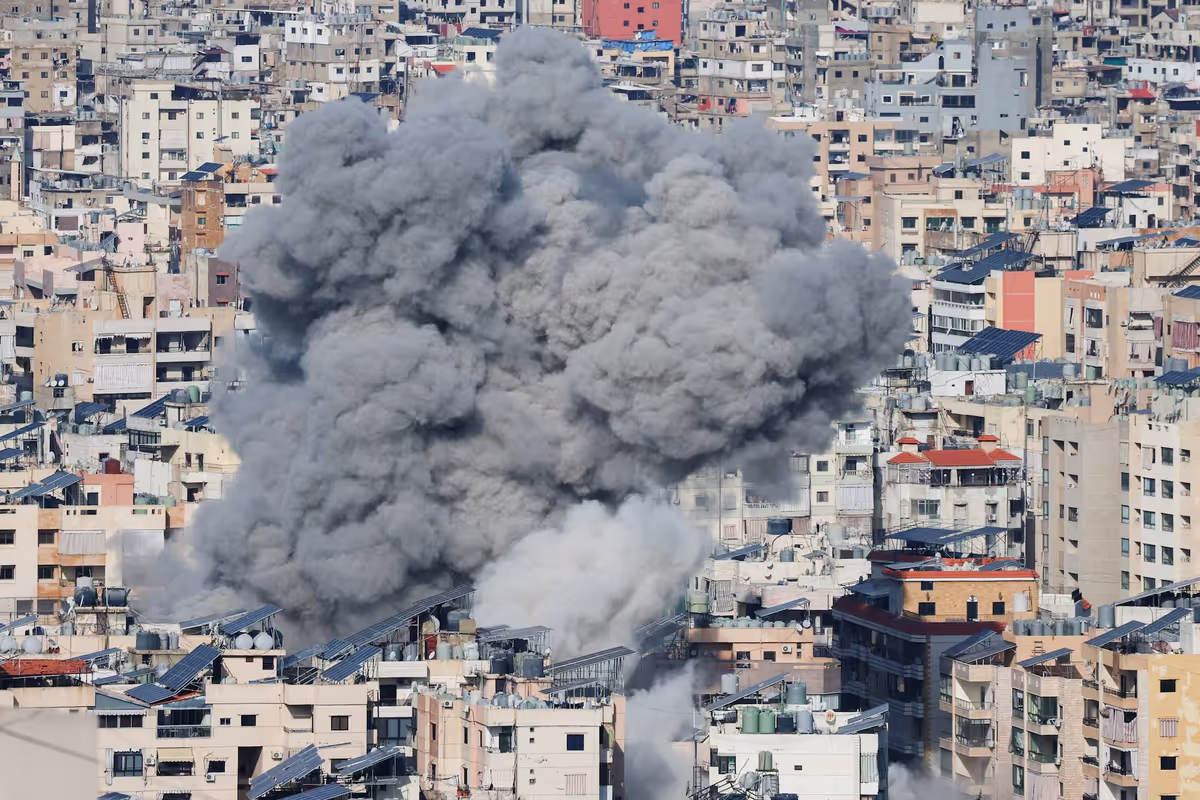
When this conflict first began, Washington projected confidence. The message was simple: four weeks and it would be over. Clean, decisive, controlled. But those four weeks quietly stretched into eight. Now the narrative has shifted again, officials are talking about another 100 days of operations, with preparations already being extended toward September 2026. That kind of timeline drift isn’t a minor adjustment. It’s a pattern. We’ve seen it before in Iraq and Afghanistan, where early declarations of quick victories slowly turned into years of open-ended engagements. Once again, the American public is being conditioned for a prolonged conflict while official messaging continues to project control and progress.
At the same time, the energy picture is deteriorating rapidly. Qatar’s massive LNG facility, one of the largest in the world and a key supplier for Europe and Asia, is now completely offline. Even optimistic estimates say that once operations resume, it will take about two weeks just to restart production and another two weeks to return to full capacity. In practical terms, that means roughly a month with zero gas output from a facility that normally feeds multiple continents. The timing could not be worse. Global LNG markets were already nervous, Europe is still dealing with the aftershocks of the Russia-Ukraine energy crisis, and now another major supply shock is entering the equation. The ripple effects will reach power plants, manufacturing sectors, and household energy bills across several regions.
For some countries the situation is even more precarious. Nations that depend almost entirely on MidEast oil reportedly have only a few weeks of strategic reserves remaining. After that, the outlook becomes uncertain. In contrast, Pakistan’s situation appears somewhat more stable for the moment. Saudi Arabia has already indicated it will continue supplying Pakistan through the Yanbu route, which provides an alternative logistical channel for oil shipments. In the middle of a volatile regional environment, that commitment from Riyadh provides Islamabad at least some short-term breathing room on the energy front.
Then there are the military claims coming from Washington. American officials recently announced that Iran’s navy had been “completely destroyed.” On paper that sounds like a decisive blow. Yet the reality in the region raises obvious questions. Iran still effectively controls the Strait of Hormuz, the narrow maritime corridor through which roughly 21 million barrels of oil pass every day, close to one-fifth of the world’s total supply. If Iran’s naval capabilities were truly wiped out, it becomes difficult to explain how Tehran continues to hold leverage over the most critical energy chokepoint on the planet. Once again, there appears to be a gap between the rhetoric of victory and the observable situation on the ground.
Iran’s long-term military planning also complicates the picture. For nearly four decades, Tehran has invested heavily in missile development and launch infrastructure. Many of these systems are believed to be stored in hardened underground facilities and mountain complexes designed specifically to survive air campaigns. The United States now claims that around 400 Iranian missile launchers have been destroyed. Even if that number is accepted at face value, only a few dozen visual confirmations have surfaced publicly. And despite these claims of significant degradation, Washington is simultaneously requesting additional air-defense systems including Patriot and THAAD batteries to protect Israel and American bases in the region from Iranian missiles and drones. More intelligence personnel are also reportedly being deployed. Those requests suggest that the earlier assessments of success may have been overly optimistic.
Taken together, the broader picture is far less decisive than initial statements suggested. Despite intense pressure and coordinated military operations, neither the United States nor Israel appears to have achieved a clear strategic breakthrough inside Iran. The situation on the ground remains fluid, and none of the underlying dynamics seem close to resolution. Even political ideas that once circulated in Western circles such as restoring figures like Reza Pahlavi as a Western backed leadership alternative, have found little traction. Inside Iran, the political consensus against externally imposed leadership remains strong.
Perhaps the most concerning development is the widening regional tension. Iran has reportedly sent messages to several regional powers, including Saudi Arabia and Turkey, emphasizing that they were not the targets of Iranian strikes and questioning who may actually be behind certain attacks. At the same time, reports have emerged of alleged Mossad operatives being detained in countries such as Qatar, Saudi Arabia, and Bahrain. Whether these incidents represent intelligence operations, counter-intelligence crackdowns, or something more complex, they illustrate just how tense and suspicious the regional atmosphere has become.
What began as a confrontation involving a few actors now carries the potential to draw in the entire Middle East. When intelligence services, covert operations, and competing narratives start intersecting across multiple countries, the margin for miscalculation becomes dangerously thin. One poorly interpreted event could escalate the situation far beyond its current boundaries.
In the end, the central pattern is becoming increasingly clear. Timelines continue to stretch, early claims of decisive victories are being quietly revised, and the actual conditions on the ground remain stubbornly resistant to simplified narratives. Conflicts of this scale rarely unfold according to the neat projections presented at press briefings. The coming months will likely reveal far more about the true balance of power in this confrontation and the global consequences may extend well beyond the region itself.
You can follow me on Facebook, Instagram, Threads, and Xreal-time to get real time updates on ongoing conflicts.