For decades, global discourse around Iran has focused primarily on geopolitics, sanctions, and its missile and nuclear programs. However, beneath this surface narrative lies a deeper structural transformation: Iran has quietly built a significant scientific and technological base across multiple advanced sectors. Today, the country is increasingly visible in global rankings across engineering, materials science, artificial intelligence, and nanotechnology.
The emerging picture suggests that Iran’s technological trajectory is not limited to defense capability but reflects a broader strategy aimed at technological sovereignty.
From Sanctions Pressure to Innovation Pressure
Economic sanctions often restrict access to foreign technology, capital markets, and scientific collaboration. Yet historically, such constraints have also forced countries to develop domestic substitutes.
Iran’s scientific ecosystem expanded significantly after the early 2000s, with growth in academic publications, engineering graduates, and research institutions. Iran has consistently ranked high globally in the proportion of graduates in science and engineering fields, creating a strong human capital base for research-intensive sectors.
Despite structural weaknesses in the investment climate and institutional efficiency, Iran produces relatively strong knowledge and technology outputs compared to its level of economic development.
This asymmetry, strong technical output despite constrained funding, helps explain why Iran appears prominently in specific frontier technologies even though its overall innovation ranking remains moderate globally.
Key Technology Domains Where Iran Shows Strength
1. Nanotechnology and Advanced Materials
Iran has become one of the most productive countries globally in nanotechnology research output. According to various bibliometric databases, Iranian scientists have published thousands of peer-reviewed papers annually in nano-related disciplines.
By 2023, Iran ranked among the top five countries globally in nanotechnology publications, contributing roughly 4–5% of total global research output in the field.
The country has also developed applied nano-products, such as:
- antimicrobial coatings
- filtration membranes
- nano-enabled construction materials
- advanced industrial coatings
More than 100 nano-focused companies have emerged through government-supported innovation programs, linking academic research to commercial applications.
Nanotechnology has strong spillover effects into:
- medicine and pharmaceuticals
- energy systems
- aerospace materials
- defense manufacturing
- water purification technologies
2. Artificial Intelligence and Neural Networks
Iranian universities produce a significant volume of academic work in artificial intelligence, especially in neural networks and pattern recognition.
Research output in artificial neural networks has placed Iran among the top countries globally in certain bibliometric rankings.
AI research clusters are concentrated in institutions such as:
- Sharif University of Technology
- University of Tehran
- Amirkabir University of Technology
Research areas include:
- Machine vision
- Speech recognition
- Predictive analytics
- Robotics
- Signal processing
These technologies have dual-use applications across both civilian and defense industries.
3. Aerospace Engineering and Satellite Capability
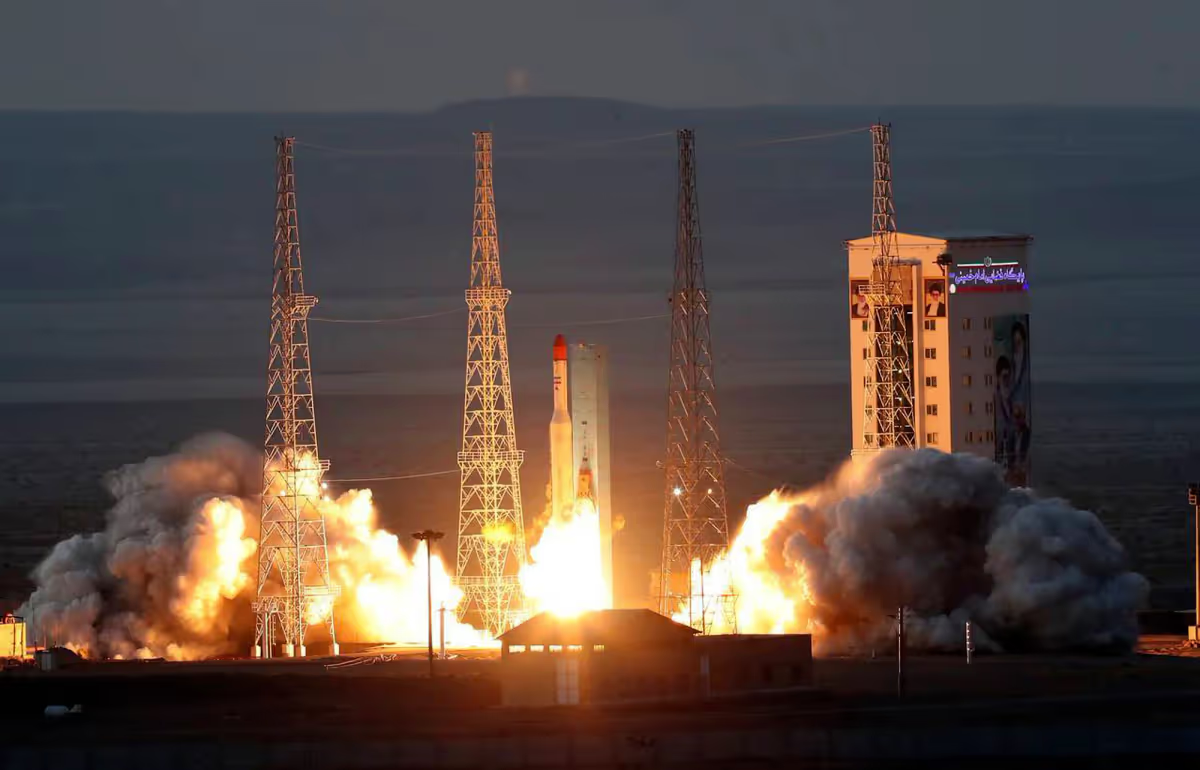
Iran is among the limited number of countries capable of designing satellites and launching them using domestically developed launch vehicles.
The country has developed orbital launch systems such as Safir and Simorgh rockets, enabling independent access to space.
Satellite development programs have included:
- Remote sensing satellites
- Communications satellites
- Scientific research payloads
Although Iranian space technology is still less advanced than that of major space powers, indigenous launch capability is strategically significant because it demonstrates mastery of guidance systems, propulsion engineering, and materials science.
4. Hypersonics, Propulsion, and Defense Engineering
According to analyses of high-impact scientific publications compiled by the ASPI Critical Technology Tracker, Iran appears among leading countries in several advanced engineering domains, including propulsion systems and advanced materials.
Research areas connected to defense applications include:
- High-temperature composite materials
- Propulsion optimization
- Aerodynamic modeling
- Control systems engineering
- Drone swarm coordination
While public data on classified defense technologies is limited, academic publication output indicates strong activity in foundational engineering disciplines relevant to aerospace systems.
5. Energy Engineering and Alternative Fuels
Iran has invested heavily in energy-related technologies due to its dual identity as both a hydrocarbon producer and a country facing domestic energy inefficiencies.
Research areas include:
- Solar photovoltaic systems
- Hydrogen fuel technologies
- Biofuels
- Smart grids
- Energy storage materials
UNCTAD frontier technology indicators show Iran performing the strongest in research and development capacity relative to peer economies.
Energy innovation is strategically important because domestic consumption growth has historically strained Iran’s electricity generation capacity.
Structural Drivers of Iran’s Scientific Output
Several structural factors explain Iran’s scientific growth trajectory:
1. STEM Education Emphasis
Iran consistently produces large numbers of engineering and science graduates, supporting domestic research output.
2. State-backed Innovation Funds
Government-backed innovation funds and technology development programs support research commercialization and startup formation.
3. Dual-use Technology Strategy
Many research programs focus on technologies that have both civilian and defense applications, increasing strategic return on research investment.
4. Scientific Publishing Focus
Iran has prioritized academic publishing output as a metric of national technological progress, contributing to high global publication rankings.
Limitations and Structural Constraints
Despite strong research output, Iran faces several structural bottlenecks:
Infrastructure gaps
Energy shortages and water management challenges continue to affect industrial productivity.
Limited venture capital ecosystem
Private investment in advanced technology startups remains limited compared to Western economies.
Restricted global collaboration
Sanctions limit access to international research partnerships, advanced equipment, and funding channels.
Innovation commercialization gap
Patent conversion rates remain relatively low compared to publication output.
Iran’s Global Innovation Index ranking of around 70 reflects this imbalance between knowledge production and commercial scaling capacity.
Strategic Implications
Iran’s scientific trajectory suggests a long-term strategy focused on technological autonomy rather than rapid integration into global supply chains.
If current trends continue, Iran is likely to strengthen capabilities in:
- Materials science
- AI-enabled engineering
- Energy technologies
- Drone and robotics systems
- Biotechnology
The broader geopolitical implication is that technological capability is increasingly distributed across a wider range of states, reducing monopoly control over advanced technologies.
Iran’s technological development story is complex. While macroeconomic indicators show structural constraints, sector-specific data reveal significant progress in high-impact research areas.
The country’s emphasis on engineering, nanotechnology, artificial intelligence, and energy systems demonstrates a deliberate effort to build indigenous technological capability despite external pressure.
Missile technology may be the most visible manifestation of Iran’s engineering capacity, but the deeper transformation is occurring within laboratories, universities, and research institutes that are shaping the country’s long-term strategic autonomy.